
Control Deficiency, Significant Deficiency, or Material Weakness?
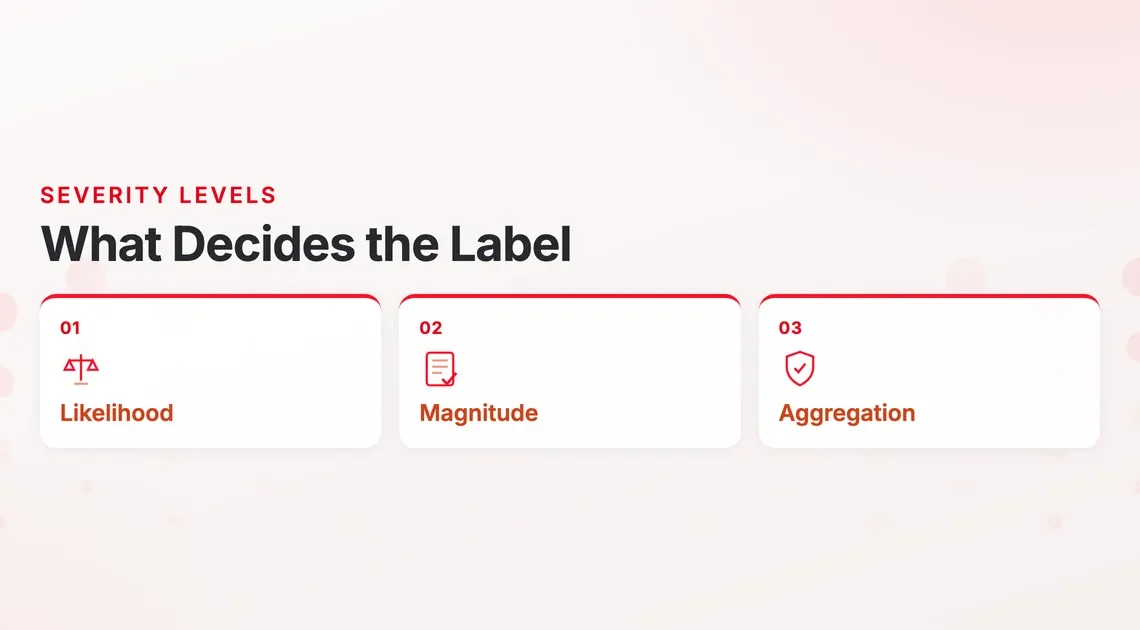
A control deficiency is the broadest category. A significant deficiency is less severe than a material weakness but important enough to merit audit-committee attention. A material weakness creates a reasonable possibility that a material misstatement will not be prevented or detected on a timely basis.
The labels are not interchangeable, and severity is not determined by whether an error happened this year. The analysis considers what the deficiency could allow, the likelihood of that outcome, and the potential magnitude.
What is a control deficiency?
A deficiency in design exists when a necessary control is missing or the existing control would not meet its objective even if it operated as designed. A deficiency in operation exists when a properly designed control does not operate as designed or the person performing it lacks the necessary authority or competence.
What is a significant deficiency?
PCAOB AS 1305 defines a significant deficiency as a deficiency, or combination of deficiencies, that is less severe than a material weakness yet important enough to merit attention by those responsible for oversight of the company’s financial reporting.
What is a material weakness?
A material weakness is a deficiency, or combination of deficiencies, such that there is a reasonable possibility that a material misstatement of annual or interim financial statements will not be prevented or detected on a timely basis.
What determines the severity of an ICFR deficiency?
The analysis focuses on two dimensions: the likelihood that the deficiency could result in a misstatement and the magnitude of the potential misstatement. The evaluation considers both quantitative and qualitative factors.
- The financial statement amounts or disclosures exposed to the deficiency.
- The susceptibility of the related asset or liability to loss or fraud.
- The subjectivity, complexity, or uncertainty involved.
- The interaction with other controls and the strength of compensating controls.
- The cause and frequency of exceptions.
- The volume of activity exposed.
- The possibility that multiple deficiencies affect the same account, assertion, process, or monitoring structure.
The absence of a known misstatement does not prove that a deficiency is minor. Conversely, an exception does not automatically establish a material weakness. The conclusion depends on the potential effect and the reasonable possibility that the control system would not prevent or detect it on time.
Can several small deficiencies combine into a material weakness?
Yes. Both significant-deficiency and material-weakness definitions expressly include combinations of deficiencies. Management should therefore evaluate findings individually and in the aggregate.
Aggregation is especially important when deficiencies:
- Affect the same account or disclosure.
- Relate to the same assertion or process.
- Share a common cause.
- Reveal a broader monitoring or control-environment weakness.
- Could interact to allow the same misstatement to go undetected.
What are indicators of a material weakness?
PCAOB standards identify circumstances that should be regarded as indicators that a material weakness exists. Examples include the identification of fraud by senior management, a restatement of previously issued financial statements to correct a material misstatement, identification by the auditor of a material misstatement that would not have been detected by the company’s ICFR, and ineffective audit-committee oversight of external financial reporting and ICFR.
An indicator requires serious evaluation; it should not be reduced to an automatic checklist without considering the applicable facts and professional requirements.
Why should management evaluate deficiencies early?
Early evaluation preserves options. Management can identify root causes, redesign controls, implement the change, allow the control to operate, and obtain enough evidence to assess whether remediation was effective.
Late evaluation can leave insufficient operating history before year-end. The standard does not require a full year of operation in every case. It requires enough evidence, considering the control’s frequency and risk, to support a conclusion that the deficiency no longer exists.
What does effective remediation require?
- Correct the root cause, not only the observed exception.
- Redesign the control when the gap is in design.
- Clarify ownership, authority, frequency, precision, and evidence requirements.
- Allow the revised control to operate for a sufficient period.
- Test the remediated control using evidence appropriate to its risk and frequency.
- Have someone with appropriate objectivity evaluate whether remediation worked.
- Reassess related and aggregated deficiencies before closing the finding.
Retroactively adding approvals to old transactions does not prove that a prospective control has been remediated. A durable fix changes the process that allowed the exception and produces reliable evidence going forward.
How should management document the classification?
A defensible evaluation records the facts, the relevant control objective, the potential misstatement, magnitude, likelihood, compensating controls, aggregation analysis, applicable indicators, conclusion, reviewers, and remediation plan. The reasoning matters more than the label alone.
Identify and prioritize ICFR gaps through an A2Q2 SOX readiness assessment
FAQ
Does every control deficiency go to the audit committee?
Auditors are required to communicate significant deficiencies and material weaknesses in writing to management and the audit committee. Other control deficiencies are communicated to management and others responsible for the control area, as appropriate under the applicable standard.
Does a material weakness require a restatement?
No. A material weakness can exist even when no material misstatement occurred. The classification addresses whether there is a reasonable possibility that a material misstatement would not be prevented or detected on a timely basis.
How long must a remediated control operate?
There is no universal one-year requirement. The period must be sufficient to generate evidence appropriate to the control’s frequency, nature, and risk.
Leave a Reply