How to Evaluate SOX Compliance Providers Without Getting Burned
The pressure to get SOX compliance right before your IPO or first audit is real — and the market of firms promising to help you do it is crowded, expensive, and remarkably difficult to distinguish from the outside. Choosing the wrong provider doesn’t just cost money. It costs time your company doesn’t have, and it can leave you exposed in front of your auditors at exactly the wrong moment.
Direct Answer
To evaluate SOX compliance providers without being misled, assess four things: their direct experience with growth-stage technology companies (not enterprise), their ability to design controls that scale without bureaucratic overhead, their cross-functional coordination capability across accounting, IT, HR, and legal, and their independence clearance timeline. Firms that can’t answer these specifically are selling general compliance, not SOX expertise.
Key Takeaways
- Big Four firms carry name recognition but are built for enterprise clients — their methodologies, staffing models, and independence clearance timelines often don’t fit growth-stage tech companies on IPO timelines
- The right provider should be able to explain the causal logic behind each control they recommend, not just cite PCAOB standards
- Cross-functional alignment — not just accounting accuracy — is the single most common failure point in first-year SOX journeys
- A provider’s remediation track record is more predictive of their value than their design capability
- Ask every prospective provider for a specific example of a control framework they built for a company at your exact stage — vague answers disqualify them
Why Is Choosing a SOX Provider So Much Harder Than It Should Be?
Every major accounting firm and most mid-market consultancies claim SOX expertise. The credential is table stakes. What they don’t advertise is whether that expertise was built inside a Fortune 500 audit rotation or in the trenches of a 200-person SaaS company trying to go public in 18 months.
Those are not the same experience. Not even close.
The surface problem is too many options with similar-sounding credentials. The real problem is that most providers are selling a framework built for a different kind of company — and they’ll customize it just enough to make it feel relevant, without fundamentally changing the approach. Understanding why conventional SOX compliance approaches break down for growth-stage tech companies is essential context before you evaluate any provider.
> The most dangerous SOX provider isn’t the one that fails visibly — it’s the one that delivers technically correct controls that quietly don’t fit your company’s operating model.
What Actually Goes Wrong When Companies Pick the Wrong Provider?
The failure mode is almost never “they didn’t know SOX.” It’s structural mismatch — a provider whose default methodology was built for enterprises with dedicated compliance teams, deep IT governance infrastructure, and six-month implementation windows.
A growth-stage tech company with 150 employees and a 10-person finance team cannot absorb that model. What typically happens: the controls get designed, documentation gets produced, and then nothing gets operationalized because the people responsible for running the controls weren’t part of designing them.
Cross-functional disconnection is the root cause of most first-year SOX failures — not technical gaps in control design.
Here’s why that matters mechanically: SOX 404 requires that controls are not just designed but operating effectively. A control that exists on paper but isn’t understood by the HR manager who runs the user access review, or the IT lead who owns the change management log, is a deficiency waiting to be found. The provider who handed over a binder of documentation and moved on didn’t fail at SOX — they failed at implementation.
Practitioners who work specifically with growth-stage companies report this pattern consistently: the documentation looks clean at handoff, and the gaps surface during testing.
The Provider Evaluation Framework: The SOX Fit Matrix
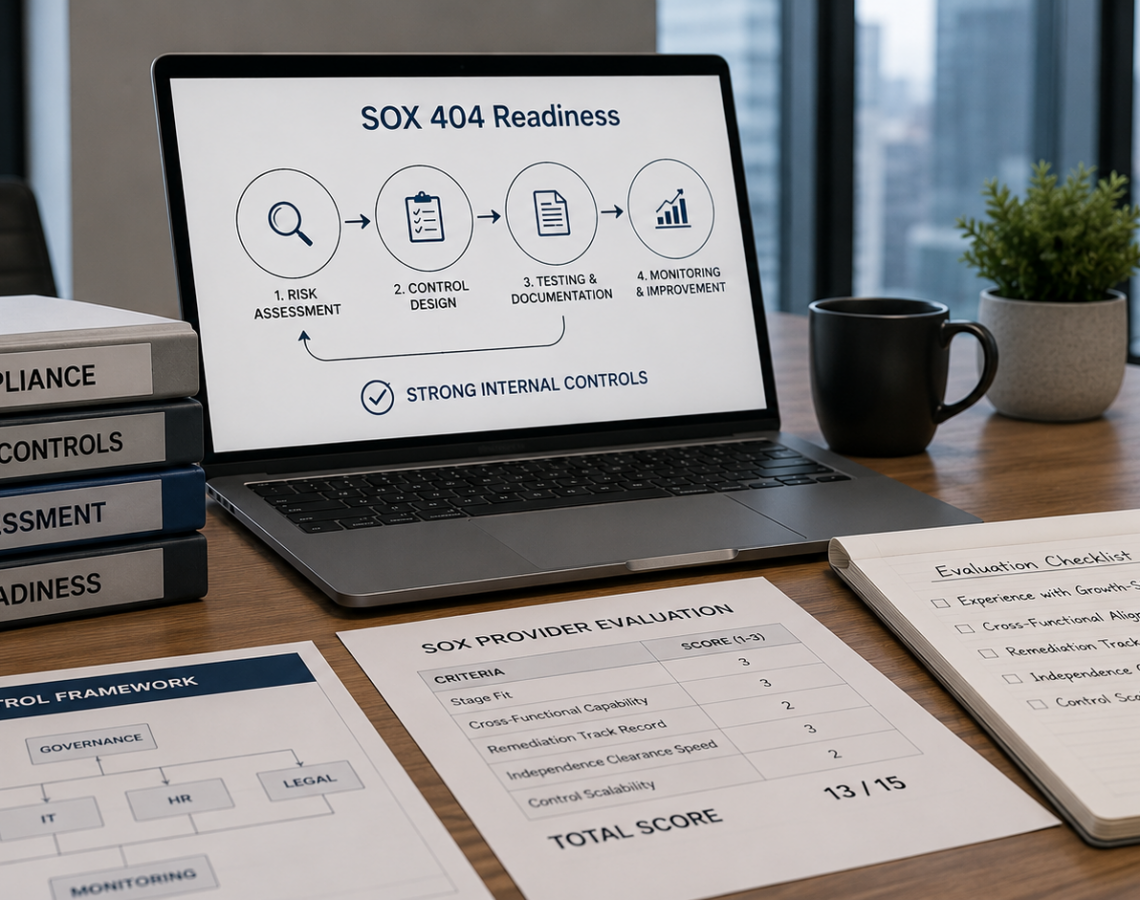
The SOX Fit Matrix is a four-dimension evaluation tool designed specifically for growth-stage technology companies assessing SOX compliance providers before engagement.
Use this when: You are evaluating two or more providers and need a structured way to surface fit gaps that sales conversations won’t reveal.
Not for: Companies already mid-engagement who need a remediation framework — that’s a different problem.
| Dimension | What to Ask | Red Flag | Strong Signal |
| Stage Fit | What percentage of your SOX clients are growth-stage tech companies under 500 employees? | “We work with companies of all sizes” | Specific client stage examples with headcount |
| Cross-Functional Capability | How do you align IT, HR, and legal to the control framework — not just accounting? | Treats it as a communication task | Has a defined coordination methodology |
| Remediation Track Record | Walk me through a material weakness you helped remediate. What was the root cause and timeline? | Generic answer or pivots to design work | Specific cause, specific fix, honest timeline |
| Independence Clearance Speed | How long does your onboarding and independence clearance process take? | “It depends” with no baseline | Named typical range (days, not months) |
| Control Scalability | How do your control frameworks change as a company grows from 200 to 1,000 employees? | Same framework for all sizes | Explicit scaling logic built into design |
Score each dimension 1–3. A provider scoring below 10 total should be disqualified regardless of brand recognition.
Isn’t a Big Four Firm the Safest Choice for SOX?
This is the most common assumption in the market — and it’s worth challenging directly.
The Big Four are not the safest choice for growth-stage tech companies. They are the most recognizable choice, which is a different thing entirely.
Here’s the mechanism: Big Four firms staff their growth-stage engagements with junior associates supervised by senior managers who are simultaneously running five other engagements. The methodology is enterprise-grade by design — built to satisfy the audit requirements of companies with $10B in revenue and dedicated compliance infrastructure. Applying it to a 200-person company doesn’t simplify it. It just creates overhead that consumes your team’s bandwidth without proportional protection.
There’s also the independence clearance issue. If your external auditor is one of the Big Four, you are may be prohibited from using that same firm for SOX advisory work — and the clearance process to confirm independence can take weeks to months. For a company on an IPO timeline, that delay is not abstract.
Mid-market firms like Grant Thornton and BDO are a step closer to the right fit, but they carry similar structural tendencies toward enterprise methodology.
The providers who consistently deliver for growth-stage tech companies are specialized firms with deep SOX experience and no enterprise overhead — firms where the senior practitioner who sold the engagement is also the one designing your controls. Knowing how to evaluate SOX compliance consulting options before your IPO window closes can help you move through this decision faster than your competitors.
What Does a Well-Designed SOX Engagement Actually Look Like at This Stage?
A well-scoped SOX engagement for a growth-stage tech company should produce three things: a controls blueprint that maps to your actual operating model (not a generic framework), a cross-functional alignment structure that gives your accounting, HR, IT, and legal teams a shared playbook, and a testing and evidence protocol your internal team can sustain without outside help after year one to three years.
That last point is where most engagements fall short.
The goal isn’t perpetual dependency on your provider. It’s building internal capability so that by year two, your team owns the controls, understands why they exist, and can defend them in front of your external auditors without a consultant in the room.
A realistic timeline for a first-year SOX 404A readiness engagement at a 150–300 person tech company: scoping and risk assessment in weeks one through fourthree, control design and documentation in weeks fivefour through 20ten, cross-functional training and walkthrough in weeks 21eleven through 36fourteen, and initial testing in weeks fifteen through twenty. That’s approximately ninefive months to a defensible first-year position — not a clean bill of health, but a documented, operating framework with identified gaps and a remediation plan.
> SOX readiness isn’t a destination — it’s the point at which your controls are operating, your team understands them, and your gaps are documented rather than hidden.
A2Q2 structures engagements exactly this way — with a defined handoff point, not an open-ended retainer. The Special Ops model means the senior strategists who design your controls are also the ones training your team to run them.
What Are the Real Tradeoffs Between Provider Types?
| Provider Type | Strengths | Weaknesses | Best Fit |
| Big Four | Brand credibility, global resources, audit alignment | Enterprise methodology, slow onboarding, junior staffing | Large public companies, complex multi-entity structures |
| Mid-Market (GT, BDO) | More accessible than Big Four, broader industry coverage | Still methodology-heavy, less specialized for tech | Mid-size companies with established compliance infrastructure |
| Specialized SOX Consultancy (e.g., A2Q2) | Deep SOX focus, managersenior-led, fast onboarding, tech-native | Smaller team, narrower service breadth | Growth-stage tech companies on IPO timelines |
| Internal Hire | Full-time ownership, cultural alignment | Expensive, hard to find, limited bandwidth in first-year SOX | Companies post-IPO building permanent compliance function |
The tradeoff that most CFOs underestimate: a specialized firm with 2018+ years of pure SOX experience will outperform a generalist firm on control architecture, control assessment, control design, and implementation testing efficiency, and auditor communication — because they’ve seen your exact situation before, not a version of it filtered through enterprise context. This dynamic is part of a broader shift in what’s working and what isn’t for growth-stage tech companies navigating SOX compliance in 2026.
Who Is This Evaluation Framework NOT For?
This framework is not useful if your company is already public with a mature internal audit function and an established SOX program. At that stage, you’re optimizing, not building — and the provider selection criteria shift significantly toward ongoing testing support and technology integration.
It’s also not the right lens if your primary compliance challenge is international operations, complex revenue recognition across multiple entities, or SEC reporting beyond SOX 404. Those require a different scope conversation.
And if your board or audit committee has already mandated a Big Four relationship for political or investor-relations reasons, this framework won’t override that decision — though it can help you scope what you actually need from that relationship versus what you source elsewhere.
Frequently Asked Questions
How do I know if a SOX provider actually has growth-stage tech experience or is just claiming it? Ask them to describe the last three SOX engagements they completed for companies under 500 employees — specifically the industry, the stage at engagement, and what the control environment looked like at the start. Providers with genuine experience will answer with specifics. Providers without it will generalize or redirect to their methodology.
How long should SOX readiness take for a company preparing for IPO? For a growth-stage tech company starting from a limited control environment, a realistic first-year SOX 404A readiness timeline is sixfour to 12six months to a documented, operating framework. That assumes a focused engagement with cross-functional participation — not a documentation exercise done in isolation by the finance team.
What’s the difference between SOX 404A and 404B, and does it change which provider I need? SOX 404A requires management’s assessment of internal controls over financial reporting. SOX 404B adds the external auditor’s attestation of that assessment and applies to accelerated filers. The provider requirements differ: 404B engagements require closer coordination with your external auditor and a higher documentation standard. If you’re heading toward 404B, your provider needs direct experience working alongside audit firms — not just designing controls in isolation.
Can we run SOX compliance internally without a consultant? Yes, eventually — and that should be the goal. But in year one, most growth-stage companies lack the internal SOX expertise to design a defensible control framework from scratch, anticipate auditor expectations, and manage cross-functional coordination simultaneously. The consultant’s job is to build the capability, not replace it permanently.
What should I do if we already have a SOX provider but I’m not confident in the work? Get an independent assessment of your current control documentation and testing before your next audit cycle. A2Q2 provides gap assessments specifically for companies in this situation — where the framework exists on paper but the operating effectiveness is uncertain. Identifying gaps early is always less expensive than remediating a material weakness after it’s found.
How do I evaluate a provider’s remediation capability, not just their design work? Ask directly: “Describe a material weakness or significant deficiency you helped remediate. What was the root cause, what controls did you redesign, and how long did it take to reach a clean opinion?” If they can’t answer that with specifics, they’ve likely never been tested under real pressure.
Is it a conflict of interest if our SOX advisor and external auditor are from the same firm? Yes, in most cases. PCAOB independence rules restrict the same firm from providing both external audit and certain advisory services to the same audit client. This is one of the practical reasons specialized SOX consultancies like A2Q2 are often a better fit — no independence clearance required, faster onboarding, and no conflict to navigate.
You’ve Done the Research. Here’s What to Do With It.
If you’ve read this far, you’re not looking for a vendor. You’re looking for a partner who has climbed this particular mountain before and knows where the ice is.
The next step isn’t a demo or a proposal request. It’s a 30-minute conversation with A2Q2 where you describe your current control environment, your timeline, and the cross-functional gaps you’re already worried about — and they tell you honestly whether they’re the right fit and what the first 90 days would actually look like.
That conversation is free. The clarity it produces is not something you’ll find in a sales deck.
Schedule your SOX readiness conversation with A2Q2.
> The provider who designed your controls and the provider who can defend them in front of your auditors should be the same person. If they’re not, you have a gap.
References
- Public Company Accounting Oversight Board (PCAOB) — Standards and guidance on auditor independence and internal control attestation requirements under AS 2201
- U.S. Securities and Exchange Commission (SEC) — Rules implementing Sections 302 and 404 of the Sarbanes-Oxley Act, including accelerated filer definitions and management’s assessment requirements for internal controls over financial reporting
- Harvard Business Review — Research on cross-functional team alignment and organizational failure modes in compliance-intensive environments
- Gartner — Research on finance function maturity and internal audit staffing models at growth-stage technology companies
Leave a Reply